
The Hidden Risks of Multiple Event Vendors: A Guide to Seamless Corporate Production
Updated: Aug 2
Hiring a different specialist for every technical niche seems like a fail-safe strategy for a high-stakes corporate event. In reality, the risks of multiple event vendors often outweigh the perceived benefits of specialization. When your sound team doesn't speak the same language as your lighting crew, the result isn't a better show; it's a series of expensive misunderstandings. You've likely felt the stress of acting as a middleman, spending hours on redundant emails just to ensure the stage and the screens are in sync.
It's frustrating when a keynote is interrupted by a technical glitch, only for each vendor to blame the other's equipment. You deserve a production that feels like a partnership rather than a collection of separate contracts. This guide will help you identify these hidden logistical hurdles and provide a clear path to a more integrated approach. We'll explore how to consolidate your oversight to achieve zero technical failures and significantly reduce your administrative workload. By the end, you'll know how to transform your next event into a smooth, professional experience with a single point of technical contact.
Table of Contents
Understanding the Risks of Multiple Event Vendors in Corporate Production
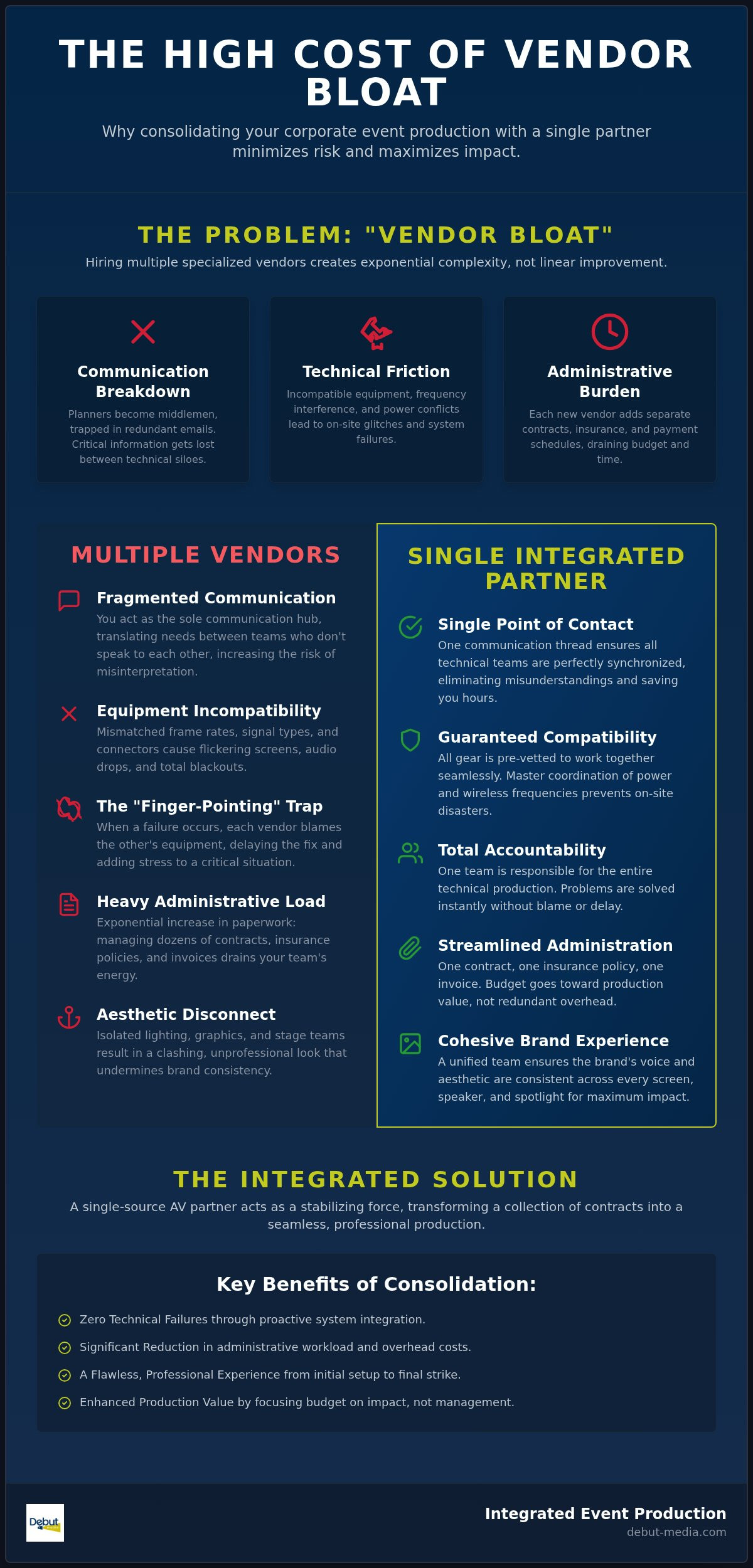
"Vendor bloat" occurs when a production becomes saturated with too many independent contractors for a single event. While it's tempting to hire a boutique specialist for every technical niche, this fragmented approach often introduces instability. In the high-stakes world of event management, complexity doesn't scale linearly; it scales exponentially. Every new vendor added to the roster represents a new potential point of failure. When you manage a dozen different entities, you aren't just a planner anymore. You're a full-time air traffic controller trying to prevent a mid-air collision.
The "more is merrier" philosophy fails because technical systems are deeply interdependent. A high-end audio team might bring the best speakers, but if they haven't coordinated with the stage builders regarding weight loads or cable paths, the production stalls. These risks of multiple event vendors manifest as technical siloes where information is trapped within individual teams rather than flowing toward a common goal. This lack of cohesion creates a psychological toll on organizers who must constantly bridge the communication gap between groups that don't naturally talk to one another.
The Administrative Burden of Fragmented Management
Planners often underestimate the sheer volume of paperwork required to maintain a fragmented vendor list. You aren't just managing a show; you're managing five separate insurance certificates, five different payment schedules, and five distinct onboarding processes. For a single gala or seminar, the administrative hours spent on redundant emails and briefing calls can drain your team's energy before the first guest even arrives. Administrative friction is the primary killer of event ROI.
Inconsistent Branding and Aesthetic Disconnects
Visual cohesion is difficult to achieve when the lighting designer and the graphic team operate in isolation. If the LED wall content uses a specific color palette that hasn't been shared with the lighting crew, the result is a clashing, unprofessional aesthetic that distracts the audience. A single-source partner ensures the brand voice remains unified across every screen and spotlight. This integration eliminates the "finger-pointing" that happens when the visual output doesn't match the client's vision. By consolidating your technical needs, you ensure that the sound, light, and stage work as a single, harmonious unit.
Beyond the paperwork, there is a hidden financial drain. Each vendor brings their own setup fees, travel costs, and minimum labor requirements. When you identify the risks of multiple event vendors, you realize that you're often paying for redundant oversight. Bundling these services with a stabilizing force allows your budget to go toward production value rather than administrative overhead.
Technical Friction: How Vendor Bloat Leads to On-Site Glitches
Technical glitches aren't usually the result of bad luck. They're often the direct consequence of hardware that hasn't been tested together. When Vendor A brings a high-resolution LED wall and Vendor B provides the media servers, a mismatch in frame rates or signal types can cause flickering or total blackouts. These risks of multiple event vendors turn a simple presentation into a high-stakes troubleshooting session. Small errors compound quickly. A slightly loose connection from one team becomes a catastrophic failure when it's buried under another team's cabling during the rush of setup.
Frequency management is another invisible hurdle that many planners overlook. Modern microphones, in-ear monitors, and wireless lighting controls all fight for the same crowded airwaves. Without a master frequency coordinator, these devices often knock each other offline at the worst possible moment. Similarly, power draw mismanagement is a common cause of mid-show disasters. If the audio lead doesn't know the lighting team is drawing 90% of the available circuit, the entire stage goes dark the moment the keynote speaker walks on. Working with a single-source partner like Debut Media ensures that every piece of gear is pre-vetted for compatibility before it ever reaches the venue.
The Finger-Pointing Trap During Technical Failures
When a projector fails mid-keynote, the immediate priority should be the fix. However, in a multi-vendor environment, the first reaction is often defense. The AV team blames the content creator, the content creator blames the laptop provider, and the planner is left standing in the middle of a silent room. This lack of ownership is a primary risk. A single point of contact eliminates the "not my department" excuse by ensuring one entity is responsible for the entire signal chain from the source to the screen.
Logistical Bottlenecks in Equipment Load-In and Strike
Coordination doesn't end when the applause stops. Managing five different "strike" schedules at the end of a gala creates a chaotic and potentially dangerous environment. Overlapping crews, tangled cables, and competing truck space in the loading dock lead to delays and safety hazards in the ballroom. Understanding what to expect during event equipment strike services can help you visualize the complexity of a clean exit. A unified team moves as one, clearing the floor faster and with significantly less risk to the venue and the equipment.
Single Vendor vs. Multiple Partners: A Strategic Comparison
Managing a corporate event with five different specialists feels like trying to assemble a puzzle where every piece comes from a different box. While some planners believe bidding out individual components saves money, the risks of multiple event vendors often manifest in administrative bloat and communication breakdowns. Instead of managing one cohesive strategy, you're stuck managing 50 email threads. A strategic partner operates as a stabilizing force, turning a transactional relationship into a long-term collaboration. This shift from a vendor-client model to a partnership model provides the expert oversight needed to catch errors before they reach the stage.
Scalability is where the single-source model truly shines. If your organization plans a national tour or a series of regional seminars, a single partner ensures the technical setup remains identical in every city. You don't have to re-explain your brand standards or technical requirements to a new crew every week. A dedicated team already knows your preferences, your hardware needs, and your "no-fail" zones. This consistency is nearly impossible to achieve when you're constantly onboarding local, fragmented teams who have no history with your brand.
Financial Transparency and Budget Control
Fragmented vendor proposals often contain overlapping management fees that are difficult to spot at first glance. Each independent vendor adds their own markup for project management, logistics, and insurance. When you bundle your production needs into a turnkey solution, these redundant costs disappear. A unified invoice provides a clear, high-level view of your spending, making it easier to track ROI and stay within budget. You'll avoid the "hidden" costs that typically arise when one vendor charges extra for labor because another vendor's equipment was late or incompatible.
Quality Control and Accountability Standards
The "technical floor" refers to the minimum standard of quality you can expect across all aspects of your production. In-house crews provide a much higher floor than the "freelancer lottery" common in multi-vendor setups. Because an integrated team works together daily, they have established protocols for safety and technical redundancy. For a deep dive into how these standards protect your event, consult our Professional Audio Visual Services Guide. Relying on a single, specialized crew ensures that the person who prepped the gear in the warehouse is the same person operating it during your keynote, ensuring total accountability from start to finish.
How to Optimize Corporate Event Vendor Management for 2026
Optimizing your production strategy for 2026 requires moving beyond simple coordination toward total integration. The landscape of corporate events now demands higher technical precision, making the risks of multiple event vendors more pronounced than ever before. To protect your event from the friction of fragmented teams, you must take proactive steps to consolidate your technical oversight. This isn't just about cutting costs; it's about building a reliable framework for success that prioritizes reliability over mere specialization.
The first step is conducting a comprehensive vendor audit to identify overlapping services. Many planners don't realize they're paying three different companies to manage the same loading dock logistics. Once you've identified these redundancies, prioritize partners with turnkey capabilities in both AV and lighting. Centralizing these core technical needs under a single project manager ensures that decisions are made with the entire production in mind. To stay organized throughout this transition, utilize a unified conference planning and management checklist to track every moving part from conception to strike.
Auditing Your Current Vendor List for Redundancy
Scope creep is a common issue in multi-vendor environments. It often happens when two different vendors both charge for "technical supervision" or "logistics coordination" without actually communicating with each other. During your audit, evaluate the technical compatibility of your current roster. Ask yourself if your audio team's hardware is designed to work seamlessly with your video provider's signal chain. To spot redundant management fees, compare the line items for labor and oversight across all current proposals to find where you're paying twice for the same result. Eliminating these overlaps provides immediate budget relief while reducing the risks of multiple event vendors.
Establishing a Unified Communication Protocol
The "One Lead" rule is the most effective way to streamline a complex production. This protocol ensures that every specialized technician reports to a single production head who understands the full scope of the event. This structure prevents conflicting instructions from reaching the crew and ensures that logistical updates are shared instantly across the entire team. For a deeper look at managing these moving parts, refer to our Corporate Event Logistics Management Guide. Establishing this clear hierarchy allows you to focus on your guests while we handle the technical heavy lifting. If you're ready to simplify your workflow, reach out to Debut Media to optimize your next event production.
Simplifying Your Production with an Integrated AV Partner
The complexity of modern corporate production doesn't have to be a source of anxiety for your team. While the risks of multiple event vendors often lead to technical friction and administrative exhaustion, an integrated partner acts as a stabilizing force. Debut Media provides a single point of contact for Audio Visual Services and Event Management, ensuring that sound, video, and lighting work in total harmony. By moving away from a fragmented model, you replace the stress of coordination with the peace of mind that comes from expert oversight. This partnership approach allows you to focus on your attendees while we handle every technical detail from initial concept to the final strike.
Our in-house approach is specifically designed for high-stakes environments like seminars, conferences, and galas. Unlike agencies that outsource their labor to various freelancers, we utilize a specialized crew for on-site operations. This ensures a consistent "technical floor" where every team member is familiar with the equipment and the specific goals of your event. Whether you are hosting a local trade show or a large-scale expo, having a dedicated team that manages the entire signal chain eliminates the gaps where glitches usually occur. We've seen how this integration transforms a chaotic setup into a methodical, efficient process that saves hours of administrative labor.
The Benefit of a Single Point of Contact
The emotional relief of having one person to call cannot be overstated. A dedicated project manager acts as the "fixer" for your production, anticipating hurdles before they become visible to your audience. This structure allows you to transition from the tedious task of managing vendors to the strategic role of leading a production. When one person oversees the audio, the visuals, and the stage management, the risk of "finger-pointing" vanishes. If a change is needed mid-show, it's communicated instantly across all departments through a unified hierarchy, ensuring a seamless response that keeps your event on track.
Turnkey Solutions for National Corporate Events
For organizations that host events across multiple US locations, consistency is the ultimate goal. Fragmented local teams often bring different equipment standards and varying levels of expertise, which can dilute your brand's professional image. An integrated partner provides a standardized equipment inventory and a familiar crew for every show, regardless of the city. This reliability ensures that your 2026 seminar in New York feels exactly like your gala in Los Angeles. From the first projector rental to the final equipment strike, we provide a turnkey solution that prioritizes your ROI and technical stability. You can simplify your next event with Debut Media’s integrated production services to experience a higher standard of corporate production.
Achieving Technical Cohesion for Your Next Production
Transitioning to a unified production model isn't just a logistical upgrade; it's a strategic move that protects your brand's reputation. We've explored how consolidating your technical needs eliminates the communication gaps and equipment clashes that often derail complex seminars and galas. By acknowledging the risks of multiple event vendors, you can proactively choose a path that prioritizes stability and professional oversight over fragmented uncertainty. You deserve a production that feels like a single, well-oiled machine rather than a collection of separate contracts.
A true partnership replaces finger-pointing with total accountability and administrative friction with streamlined ease. Debut Media brings professional sound, video, and lighting under one roof, providing a single point of contact for all your event logistics. Our specialized crew is ready for national turnkey execution, ensuring your production standards remain high in every city you visit. Streamline your production with Debut Media’s turnkey AV services to reclaim your time and ensure your next event is a flawless success. We're here to help you lead your production with total confidence.
Frequently Asked Questions
What are the primary risks of using multiple vendors for a corporate event?
The primary risks of multiple event vendors include technical incompatibility between separate hardware sets and a lack of accountability when glitches occur. When different crews manage sound, lighting, and video, they often operate in siloes. This fragmentation leads to communication gaps that can cause mid-keynote failures. It also forces the event planner to act as a technical mediator; this increases the likelihood of human error during high-pressure setups.
How does vendor consolidation save money on event production?
Consolidation saves money by eliminating overlapping management fees and redundant logistics costs hidden in fragmented quotes. Instead of paying five different companies for truck transport and project oversight, you pay for these services once. A bundled turnkey solution also reduces total labor hours because a single, integrated crew works more efficiently than separate teams. This streamlined approach prevents the hidden costs associated with technical delays caused by vendor friction and miscommunication.
What should I look for in a single-source AV and production partner?
Look for a partner that maintains an in-house crew and owns their equipment inventory rather than outsourcing to freelancers. You need a team with proven experience in your specific event type, whether it's a trade show or a corporate gala. A reliable partner should offer a single project manager who acts as your fixer for all technical needs. This ensures that the person planning the event is the same person overseeing the on-site execution.
Can one vendor really handle sound, lighting, and event management effectively?
Yes, an integrated production house is specifically designed to manage these interdependent services as a single unit. Because sound, lighting, and video all rely on the same power and signal infrastructure, having one team manage them is actually more effective than splitting them up. This structure ensures that every technical decision supports the overall event strategy. It replaces fragmented communication with a clear, authoritative hierarchy that guarantees a more stable show environment.
How do I transition from multiple vendors to a single partner without issues?
Start by conducting a vendor audit to identify overlapping services and redundant administrative fees in your current roster. Once you've identified these gaps, transition your core technical needs, like AV and lighting, to a single partner first. This allows you to centralize your communication through one project manager while phasing out fragmented contracts. Clear documentation of your previous technical requirements will help your new partner ensure a seamless transition while reducing the risks of multiple event vendors.
What happens if a single-source vendor has a technical failure?
If a failure occurs, a single-source vendor takes total accountability and can resolve the issue faster because they own the entire signal chain. There is no time wasted on finger-pointing or debating whose equipment is at fault. The crew has a comprehensive understanding of the entire system, allowing them to implement redundancies and fixes immediately. This integrated oversight provides a level of technical security that fragmented teams simply cannot match.
Does using one vendor limit my creative options for a gala?
On the contrary, a single partner often enhances creative options by ensuring that ambitious designs are technically feasible. When the lighting designer and the video team work for the same company, they can synchronize their efforts to create a unified aesthetic. This prevents the clashing visuals that often occur when separate vendors work in isolation. You get a more cohesive look and feel that accurately reflects your brand's vision across every screen and spotlight.
Is it better to use the venue's in-house AV or a third-party integrated partner?
A third-party integrated partner is often the better choice for high-stakes corporate events because they provide a dedicated crew that stays with you across different locations. While venue AV is convenient, it often relies on rotating staff who may not understand your brand's specific technical standards. An independent partner like Debut Media offers specialized oversight and turnkey solutions that are tailored to your long-term goals rather than just the venue's house equipment.


