
Corporate Event Logistics Management: The Definitive Guide to Flawless Execution
Updated: Jul 11
A flawless corporate event is not merely the result of a detailed schedule; it is the strategic integration of technical production into every operational phase. When you oversee corporate event logistics management, you've likely felt the mounting anxiety of juggling fragmented vendors while worrying if the technical setup will hold during a high-stakes keynote. It's exhausting to act as the constant middleman between various teams during the high-pressure windows of load-in and load-out, especially when one small oversight can disrupt the entire attendee experience.
We understand that you need more than just a checklist. You need a professional framework that eliminates friction and ensures a seamless execution for every participant. This guide will show you how to master the complexities of event planning by integrating technical production and operational strategy into one cohesive plan. We'll walk through a methodical process to consolidate your vendor communication, secure your technical infrastructure, and regain your peace of mind through expert oversight. By the end of this guide, you'll have the tools to transform your next event from a logistical hurdle into a flawless brand experience.
Table of Contents
What is Corporate Event Logistics Management?
At its core, corporate event logistics management is the strategic planning and integration of every operational and technical requirement necessary to execute a professional gathering. While many view it as a simple series of tasks, it's actually the invisible foundation of the attendee experience. When logistics are handled correctly, the audience focuses entirely on your message; when they fail, the friction becomes the only thing they remember. Within the broader field of Event management, logistics represents the precision-engineered machinery that turns a creative vision into a tangible reality.
By 2026, the industry has moved away from simple coordination toward complex production management. Events are no longer just meetings; they are high-stakes brand experiences that require seamless synchronization between venue constraints, technical infrastructure, and vendor workflows. This evolution has transformed corporate event logistics management into a discipline of risk mitigation and technical mastery. You're no longer just planning a meeting; you're managing a complex production that requires a stabilizing force to ensure every moving part works in harmony.
The Core Pillars of Modern Event Logistics
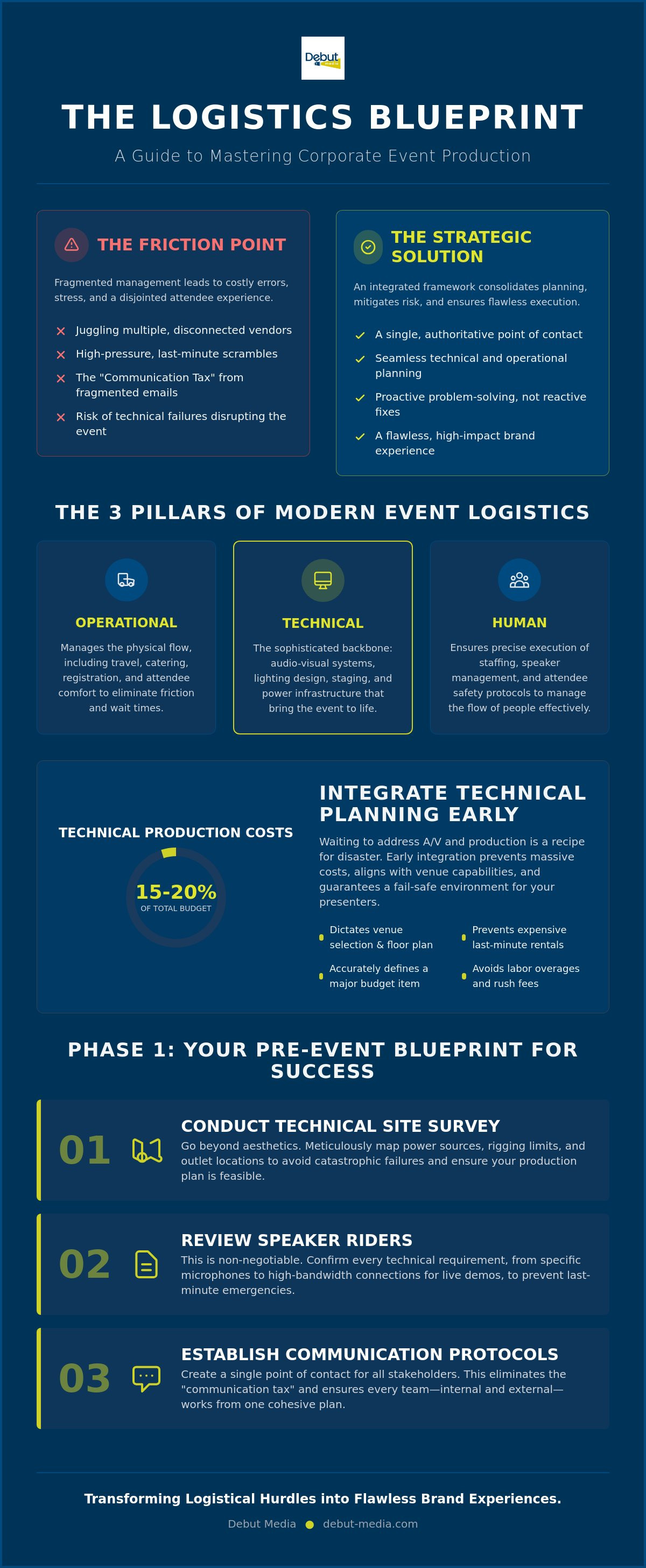
To achieve flawless execution, we categorize logistics into three distinct pillars that must be managed simultaneously:
Operational Logistics: This covers the physical movement and comfort of attendees, including travel arrangements, catering schedules, and registration flows designed to eliminate wait times.
Technical Logistics: This involves the sophisticated backbone of the event, such as high-end audio-visual systems, custom lighting designs, and integrated stage production.
Human Logistics: This ensures that staffing, speaker management, and attendee safety protocols are executed with precision, managing the flow of people through a space to prevent bottlenecks.
Why Technical Integration Matters Early
Waiting until the final weeks to address technical needs is a recipe for disaster. Early integration is essential because audio-visual requirements often dictate venue selection and floor plans. You can't host a high-definition LED wall in a ballroom with low ceilings or insufficient power rigging without incurring massive structural costs later.
Technical logistics also significantly impact the overall event budget. Since production typically accounts for 15% to 20% of total event costs according to industry standards, early planning prevents expensive last-minute equipment rentals or labor overages. A technical rider is a comprehensive document that details the specific audio, visual, and staging requirements a speaker needs to deliver their presentation effectively. Integrating these riders into your initial strategy ensures that your venue and vendor choices align perfectly with your content goals, providing a fail-safe environment for your presenters.
Phase 1: The Blueprint for Flawless Pre-Event Planning
Mastering corporate event logistics management begins long before the first attendee arrives. It's a phase defined by meticulous scrutiny and the intentional elimination of potential failure points. While general planners often focus on venue aesthetics, a professional framework prioritizes technical feasibility. You're building a blueprint that ensures every cable, microphone, and stage piece has a designated place and a confirmed power source. This level of foresight is what separates a standard meeting from a high-impact production.
A comprehensive technical site survey is your first line of defense. You must identify power and rigging limits to avoid catastrophic failures during the event. This involves mapping out the exact locations of floor boxes and wall outlets to ensure your production team doesn't overload circuits. Simultaneously, reviewing speaker riders is non-negotiable. You need to know if a keynote presenter requires a specific headset or a high-bandwidth connection for live demonstrations. Addressing these needs early prevents the frantic, last-minute scrambles that often occur just minutes before a presentation starts.
Communication protocols keep the entire engine running. You should establish a single point of contact for all internal and external stakeholders to avoid the "communication tax" of fragmented emails. If you're feeling overwhelmed by these technical requirements, partnering with an experienced event management team can provide the stabilizing force your project needs to stay on track.
Venue Sourcing Through a Technical Lens
When you evaluate a space, look past the decor and focus on the infrastructure. High ceilings are essential for projection and lighting rigs; without enough clearance, your visual impact is severely limited. You also need to verify house power availability. If the venue can't support your AV load, you'll face the unexpected expense of generator rentals. Checking dock access and freight elevator dimensions is equally critical. If your gear won't fit in the elevator, your load-in schedule will collapse before it even starts. Following Event Logistics: Best Practices involves more than just a checklist; it requires a deep dive into the venue’s physical constraints to ensure they align with your technical goals.
The Master Production Timeline
The "pre-con" meeting is the most important hour of your planning phase. This is where you bring all key vendors together to synchronize the master production schedule. It's the time to set realistic benchmarks for equipment delivery and setup, ensuring that corporate event logistics management remains a controlled process rather than a series of emergencies. A well-structured timeline includes dedicated windows for load-in, lighting focus, and soundchecks. These buffers are your safety net. They give your technical team the time they need to perfect the environment, ensuring that when the first slide hits the screen, it's nothing short of flawless.
Phase 2: Masterful On-Site Management and Technical Production
Execution is where the true value of your planning is tested. This is the moment corporate event logistics management moves from a digital document to the physical venue floor. It starts with the load-in process. You need a team that oversees the arrival and placement of every piece of equipment, ensuring gear is handled safely and positioned exactly where it belongs. This methodical approach prevents the chaotic delays that often steal time from your final rehearsals. When you manage the physical arrival of technology with precision, you set a professional tone that carries through the entire event.
The "Show Flow" is your most vital tool during the active event. It's a minute-by-minute script that synchronizes every technical cue, from the first lighting transition to the final microphone hand-off. It ensures the audio, video, and lighting teams operate as a single unit rather than fragmented groups. Without this script, cues are missed and the professional image of your brand suffers. We also prioritize technical redundancy for all critical hardware. This means having a secondary microphone live and a backup projector already cabled and synced. Technical redundancy for high-stakes keynotes acts as a fail-safe that ensures the presentation continues without a glitch even if a primary device fails.
Managing the 'Show Day' Chaos
A Technical Director is your stabilizing force when the lights go up. They act as the master coordinator who handles the real-time synchronization of all technical elements. When a speaker makes a last-minute change to their slides or a media file won't load, the Technical Director fixes the issue quietly behind the scenes. This prevents the audience from ever knowing there was a problem. It's about maintaining an authoritative, calm presence while navigating the live variables of the show day.
Efficient Equipment Strike and Teardown
The work doesn't stop when the applause ends. In fact, "the strike" is often the most hazardous part of the event for equipment and staff. Fatigue is high, and the pressure to clear the room quickly can lead to accidents or lost gear. A professional approach to corporate event logistics management includes a methodical teardown where every rental is accounted for and every cable is properly stored. Post-event asset management ensures that all materials are safely returned and the venue is restored to its original condition. To learn more about this final phase, read our guide on What to Expect During Event Equipment Strike Services. This disciplined approach ensures that your event finishes as smoothly as it began.
The Hidden Cost of Fragmented Vendor Management
Managing multiple vendors creates a "Communication Tax" that drains your most valuable resource: time. When corporate event logistics management is split between five different companies, the planner becomes the default IT support and mediator. This fragmentation leads to misaligned expectations where critical details slip through the cracks of separate email threads and conflicting schedules. You end up spending your day repeating instructions instead of focusing on the high-level strategy of your event.
Technical gaps are a significant risk when specialized teams don't collaborate. If the sound company and the video company don't talk during the pre-planning phase, you risk audio-sync issues or incompatible signal formats during the live show. These gaps aren't just annoying; they're professional liabilities that distract your audience from the message. A single-source production partner acts as a stabilizing force, ensuring that every technical department is perfectly synchronized from day one.
Budget bloat is the most tangible result of a fragmented approach. You end up paying for overlapping delivery fees, separate management overheads, and redundant labor hours. Each vendor brings their own logistics team, which increases the number of people you have to feed, house, and manage. Consolidating these services protects your budget from unnecessary inflation and ensures that every dollar spent contributes directly to the attendee experience.
Single Point of Contact vs. Multi-Vendor Chaos
A single point of contact significantly reduces logistical friction. Instead of chasing three different account managers for a single status update, you have one authoritative partner who understands the entire scope of the event. This turnkey approach provides a higher level of accountability. When one entity is responsible for the entire production, there's no room for the "blame game" that often occurs when technical issues arise on-site. Industry data suggests that integrated AV and management can save between 15% and 20% on administrative overhead compared to the cost of managing a fragmented team.
Simplifying the Planning Workflow
Streamlining your workflow means having fewer contracts to sign, fewer invoices to process, and fewer meetings to attend. It allows for a standardized technical rider across all event sessions, ensuring consistency in quality and execution across multiple rooms or days. This cohesion is what creates a professional, polished feel for your brand. If you're ready to eliminate the stress of coordinating multiple teams, partner with Debut Media for a single-source solution that integrates technical mastery with flawless operational planning.
By moving away from a transactional multi-vendor model, you gain a partner who is invested in your long-term success. We help you choose between a single vendor vs. multiple event production partners by showing you exactly where the efficiencies lie. This shift doesn't just save money; it provides the emotional relief of knowing that every moving part is being watched by a single, experienced eye.
Partnering for Success: Professional Management Solutions
Professional corporate event logistics management isn't a line item to be trimmed; it's a strategic investment in your event's return on investment. High-quality execution ensures that your brand's message isn't lost to technical glitches or operational friction. When you partner with a specialist, you're buying more than just Audio Visual Services or labor. You're securing the peace of mind that comes from knowing every variable has been accounted for by a seasoned team. 87% of corporate executives believe face-to-face meetings are essential for building strong business relationships, and our goal is to ensure those meetings are never interrupted by preventable failures.
The Debut Media approach integrates technical mastery with comprehensive operational planning to create a seamless attendee journey. We replace the stress of fragmented communication with a single, authoritative point of contact. This cohesion is essential for maintaining brand trust. When you look for a production partner, prioritize experience and equipment quality, but also look for the reassurance of a stabilized workflow. To get started, we recommend a comprehensive logistical audit of your next event to identify gaps in your technical infrastructure or vendor synchronization before they impact your live show.
The 'Fixer' Mentality in Event Production
We operate with a "fixer" mentality. Our role is to be the stabilizing force that identifies potential hurdles before they become public failures. Expert oversight eliminates the anxiety of technical details because you know a master coordinator has already verified the rigging, the power load, and the signal flow. Reliability is built on having a Plan B ready for every scenario. Whether it's a failed laptop or a last-minute schedule shift, a professional partner has seen it all and has a solution ready to deploy quietly behind the scenes.
This commitment to reliability extends to the maintenance of the transport and power equipment that makes the production possible; for teams managing their own technical fleets, the option to explore Battery Testers and Chargers provides an extra layer of security against mechanical downtime.
Turnkey Solutions for Seminars, Conferences, and Galas
Whether you're hosting an intimate seminar or a large-scale gala, our solutions are customized to fit your specific scale and goals. We provide comprehensive support that ranges from Projector and Screen Rentals to full-scale Trade Show & Expo Support. We can even integrate graphic design into the master plan to ensure visual consistency across all digital and physical touchpoints; to ensure these items arrive on schedule, visit Linemark for a guide on tracking your event shipments. This turnkey approach allows you to focus on your content and your guests while we handle the heavy lifting of physical production and vendor synchronization.
Success in modern event planning requires a shift from simple coordination to expert production management. By centralizing your logistics, you eliminate the "communication tax" and protect your budget from unnecessary bloat. If you're ready to experience the relief of a perfectly executed event, it's time to change your approach. Streamline your next event with Debut Media's professional logistics management and ensure your message is delivered with absolute clarity.
Elevate Your Next Event with Strategic Oversight
Success on the event floor is built during the meticulous planning phases we've discussed. By integrating technical production into your initial blueprint and consolidating your vendor list, you eliminate the logistical friction that often plagues complex corporate gatherings. Masterful corporate event logistics management doesn't just prevent technical glitches; it provides the emotional relief of knowing every detail is being watched by a professional eye. You've learned how a unified approach protects your budget and ensures your message is delivered without interruption.
Our team acts as your single point of contact for both AV and management, providing a professional crew to handle everything from the initial technical setup to the final equipment strike. Whether you're planning national seminars, large-scale conferences, or elegant galas, we have the experience to act as your stabilizing force. It's time to move away from the chaos of fragmented communication and toward a partnership built on reliability and expert oversight. Request a Turnkey Logistics Proposal for Your Next Event today. We look forward to helping you execute your vision with absolute precision.
Frequently Asked Questions
What is the difference between event planning and event logistics?
Event planning focuses on the conceptual vision, such as the theme, content strategy, and attendee goals. In contrast, corporate event logistics management handles the physical execution and the machinery that makes the vision possible. This includes managing technical signal flows, power distribution, freight movement, and the minute-by-minute synchronization of on-site staff.
How much should I budget for corporate event logistics management?
You should typically allocate between 15% and 20% of your total event budget for production elements like audio-visual systems and staging. This range is a standard industry benchmark for professional productions. Investing in this area early protects your larger venue and catering investments by ensuring the actual experience runs without technical friction or delays.
What is included in a technical site survey for a venue?
A technical site survey is a detailed audit of the venue's infrastructure to ensure it can support your specific production goals. We verify the location and capacity of house power circuits, ceiling heights for lighting rigs, and the exact placement of floor boxes. We also measure dock access and freight elevator dimensions to prevent equipment transport issues during the load-in phase.
Can one vendor handle both AV and event management?
Yes, a single-source production partner can manage both your technical audio-visual needs and the broader operational logistics. This consolidation is often the most efficient choice because it eliminates the communication gaps caused by managing multiple fragmented teams. It creates a stabilized environment where the technical director and the event manager work from the same master production schedule.
How do I ensure there are no technical glitches during a live keynote?
You ensure a fail-safe performance by implementing technical redundancy for all critical hardware. This involves having backup microphones live and secondary projectors cabled and ready for an immediate switch if a primary device fails. A professional team also conducts full-scale soundchecks and slide reviews well before the audience enters the room to identify and fix any media format issues.
What happens during the equipment strike phase of an event?
The equipment strike involves the systematic teardown and removal of all production gear immediately after the event ends. Our crew focuses on safe handling and asset management to ensure all rentals are accounted for and returned without damage. We also restore the venue to its original state, which fulfills your contractual obligations to the facility and prevents late-exit fees.
How early should I start the logistical planning process for a 500-person conference?
You should begin your logistical planning at least six to nine months in advance for a conference of this scale. This timeframe allows you to secure your preferred venue and conduct technical surveys before the floor plan is finalized. Starting early ensures that your technical requirements help dictate the space selection rather than trying to force technology into an unsuitable room later.
What are the most common logistical mistakes in corporate events?
The most frequent errors include waiting too long to integrate technical requirements and failing to establish a single point of contact for all vendors. Many planners also overlook venue power limits, which leads to unexpected costs for generator rentals during the show. Effective corporate event logistics management avoids these pitfalls by prioritizing technical feasibility during the very first site visit.


