
Large Venue Projector Rental: The 2026 Guide to Flawless Event Visuals
A keynote speaker's most powerful moment can be instantly undermined by a washed-out slide or a flickering screen. In a cavernous ballroom, your visuals aren't just an accessory. They are the primary lens through which your audience perceives your brand's authority and attention to detail. Securing a large venue projector rental shouldn't feel like a high-stakes gamble where you're left crossing your fingers during the opening remarks.
We understand the pressure of managing complex technical requirements while trying to maintain a professional atmosphere. You deserve a setup where the image is crisp, the brightness overcomes ambient light, and every attendee has a perfect view. This guide will help you master the logistical essentials of high-impact projection to ensure your next corporate event is visually stunning and technically seamless. We will walk through the critical steps of equipment selection, the necessity of professional rigging, and how a managed service model provides the single point of contact you need for total peace of mind.
Table of Contents
What defines a Large Venue Projector Rental?
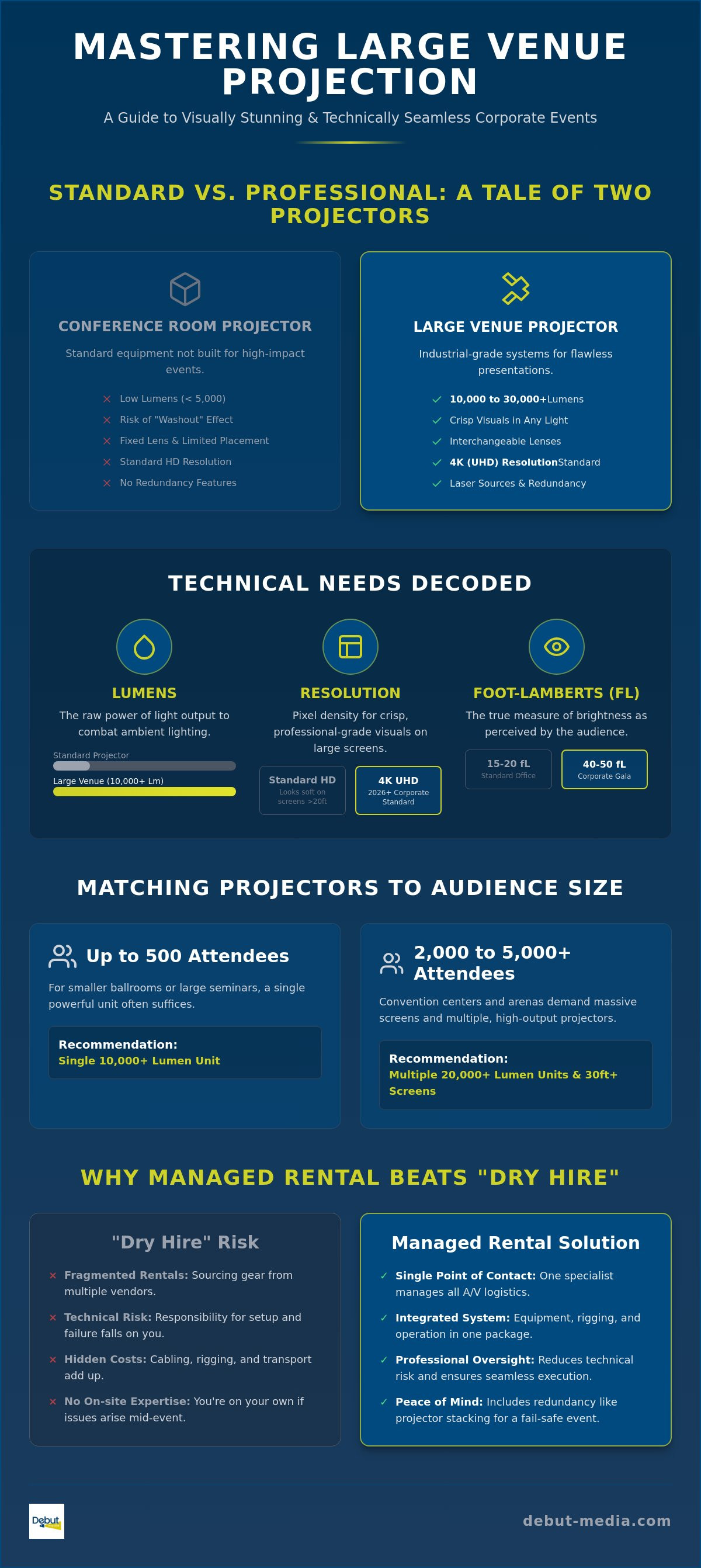
A large venue projector rental isn't simply a bigger version of the device in your conference room. It is an industrial-grade video projector engineered to throw clear, vibrant images over distances exceeding 100 feet. These systems typically start at 10,000 lumens and can reach up to 30,000 or more. They are purpose-built for ballrooms, convention centers, and arenas where standard equipment would fail to make an impact. You aren't just renting hardware; you're securing a system capable of overcoming massive architectural and lighting challenges.
Unlike consumer models, these units feature interchangeable lenses to accommodate various throw distances and screen positions. They include advanced cooling systems for long runtimes and redundant light sources to prevent total failure during a live presentation. By 2026, laser technology has become the definitive standard for high-stakes environments. Laser projectors offer up to 20,000 hours of consistent brightness and eliminate the risk of a lamp burning out mid-keynote. This shift ensures your visuals remain stable and professional from the first slide to the closing remarks.
The "large venue" classification signals that your project requires specialized technical oversight. Securing a professional large venue projector rental means accounting for heavy-duty rigging, high-bandwidth signal distribution, and precision calibration. These machines are heavy and require secure mounting to venue trusses or dedicated towers. It is a logistical feat that demands a coordinated approach to ensure every technical component works in harmony.
Projector Brightness: Why Lumens are the Priority
Lumens measure the total light output of the projector. In a massive venue, you're competing with house lights, stage lighting, and sometimes natural sunlight. If your lumen count is too low, you will experience the "washout" effect. This is where colors look grey and text becomes unreadable for anyone past the third row. For large screens, we recommend a minimum of 10,000 lumens. This ensures your content stays vibrant and commands the attention of every attendee in the room.
Resolution and Aspect Ratio for Professional Impact
In 2026, 4K (UHD) resolution is the baseline for large-scale corporate presentations. On a screen larger than 20 feet, standard high definition looks soft and pixelated. High pixel density is vital for displaying detailed financial charts or high-quality brand videos without visual artifacts. We also ensure your aspect ratio matches your content. While 16:9 is common, many large venue setups use 16:10 to provide extra vertical space for presentation notes or sidebars. Matching these technical specs ensures your brand looks polished and modern.
Calculating Technical Needs: Lumens, Lenses, and Lighting
Successful event visuals rely on physics, not guesswork. When you arrange a large venue projector rental, the first technical metric to consider is the "Foot-Lambert" (fL) calculation. This measures how much light actually reflects off the screen toward the audience. While a standard office might only need 15 to 20 fL, a high-stakes corporate gala with complex stage lighting requires 40 to 50 fL to maintain contrast. If your provider isn't discussing fL, they aren't planning for the room's actual environmental conditions.
Coordination with the lighting designer is another non-negotiable step. High-intensity stage washes can easily wash out a screen if the projector lacks sufficient output. For mission-critical events, we often recommend "stacking" two projectors. This involves aligning two units to project the exact same image. It provides an instant fail-safe; if one unit loses power, the other continues the presentation without a second of downtime. This level of redundancy is a cornerstone of professional Audio-Visual Standards and is essential for high-profile keynotes where technical failure isn't an option.
Matching Projectors to Audience Size
Audience size dictates your screen scale, which in turn dictates your lumen needs. For a crowd of 500, a single 10,000-lumen unit might suffice. However, for 2,000 to 5,000 attendees in a convention hall, you likely need multiple 20,000-lumen units and massive 30-foot screens. Room depth is equally critical. The further back the audience sits, the larger the image must be to ensure legibility. We analyze the venue's sightlines to ensure every attendee, from the front row to the very back, has a clear view of your content.
Lens Selection: The Secret to Venue Flexibility
The lens is the unsung hero of venue flexibility. Whether you're using a long-throw telephoto lens to project from a booth at the back of the room or an ultra-short-throw lens to hide equipment behind a screen, the right glass is vital. High-quality interchangeable lenses ensure edge-to-edge sharpness, preventing the blurry corners often seen in lower-end consumer setups. Selecting the right configuration is a complex task, which is why our team provides comprehensive Audio Visual Services to handle these calculations for you.
The Logistical Blueprint: Setup, Rigging, and Strike
A successful event doesn't happen by accident. While the previous sections focused on the hardware, this section focuses on the execution. A large venue projector rental is a complex logistical operation that requires precise coordination between technical teams and venue management. Choosing a single vendor to handle both the hardware and the installation eliminates the communication gaps that often lead to technical failures. When one team manages the entire technical blueprint, they take full responsibility for every cable, mount, and signal path.
Rigging is where safety meets performance. These high-output projectors often weigh over 100 pounds; they require more than just a sturdy table. Professional rigging involves securing equipment to venue trusses using rated hardware and secondary safety cables. This isn't just about getting the right angle for the screen. It is about protecting your audience and meeting strict venue safety standards. Our team treats rigging as a core service rather than an afterthought, ensuring that every overhead component is verified for structural integrity before the first attendee arrives.
Maintaining image quality over long distances is the next technical hurdle. In large convention halls, the distance between the media server and the projector can frequently exceed 300 feet. Standard HDMI cables fail at these lengths, leading to signal dropouts or digital noise. We utilize fiber optic or HDBaseT signal distribution to ensure your 4K content arrives at the lens without any degradation or lag. This infrastructure is the invisible backbone of a stable, high-impact visual presentation.
Professional Technical Operation
A professional projectionist does much more than just press play. During the event, they provide continuous on-site event technical operation to monitor the health of the entire system. This includes adjusting for heat buildup in the projector housing, managing signal fluctuations, and executing seamless input changes between different speakers. This active oversight is your best insurance against the unexpected glitches that can derail a high-profile keynote.
Eliminating Logistical Friction
Logistical friction often stems from overlooked details like power constraints or structural limitations of the venue. We conduct pre-event site surveys to identify these hurdles weeks before the doors open. This proactive approach ensures we have the right power drops and mounting solutions ready on day one. Finally, the strike process is handled with the same precision as the setup. We remove all equipment efficiently, respecting venue timelines and protecting your security deposit. Having a single point of contact for all technical needs turns a stressful load-out into a managed, orderly exit.
Planning Your Rental Package: Screens and Accessories
A large venue projector rental package is incomplete without the right screen and signal infrastructure. While the projector provides the light, the screen material, known as "gain," determines how that light reaches the audience. High-gain surfaces reflect light more intensely toward the center. This is useful in bright rooms but can narrow the viewing angle for those on the sides. Matte white surfaces, on the other hand, provide a uniform image for attendees sitting at the far edges of the venue, ensuring no one misses the details of your presentation.
The physical mounting of your screen also impacts the event's professional feel. Fast-fold screens are portable and stand on their own legs, making them a practical and efficient choice for seminars. For a more permanent or high-end gala aesthetic, truss-mounted screens are suspended from the ceiling. This removes floor obstructions and creates a sleek, floating appearance that reflects well on your brand's sophistication. We help you choose the mounting style that fits both your venue's constraints and your desired visual impact.
Selecting the Right Screen Type
Deciding between front and rear projection depends on your venue's footprint. Rear projection hides the hardware behind the screen for a cleaner stage, though it requires dedicated space behind the backdrop. Front projection is more space-efficient but requires precise lens selection to avoid shadows from presenters. We often utilize perforated screens for integrated sound stages, which allow speakers to be placed directly behind the screen without muffling the audio. This level of technical integration is a key component of our Audio Visual Services, ensuring that your visuals and sound are perfectly aligned.
Essential Signal Management Hardware
Reliable visuals require more than just a cable. Seamless switchers allow our technicians to transition between different presenters and video sources without the audience ever seeing a flicker or a black screen. For ultra-wide displays, we use image processors to blend the output of multiple projectors into one continuous image. We also prioritize redundancy by maintaining a "hot-swappable" secondary signal path. If the primary feed encounters an issue, the system instantly switches to the backup without a visible interruption. To secure a setup that guarantees this level of stability, you can explore our comprehensive Projector and Screen Rentals for your next corporate event.
Why Managed Rental Beats "Dry Hire" for Corporate Events
Choosing a "dry hire" model where you only rent the hardware might seem like a way to reduce your budget. However, this approach shifts the entire technical burden onto your internal team. For a large venue projector rental, the complexity of rigging, signal processing, and precision calibration is too high for a DIY approach. A managed rental provides a necessary safety net. It ensures that if a signal drops or a setting needs adjustment, an expert is already on-site to handle it instantly.
Risk mitigation is the primary reason corporate planners choose managed services. Technical glitches don't just interrupt a presentation; they reflect poorly on your brand's authority. Fragmented vendors often lead to finger-pointing when a problem arises. By contrast, a single-source provider takes full ownership of the visual outcome. This eliminates the hidden costs of troubleshooting and emergency labor that often plague dry hire agreements.
Debut Media acts as a stabilizing force in the often chaotic environment of event production. We replace fragmented communication with a single, organized entity. This moves the relationship from a transactional gear rental to a partnership-based approach. Our authoritative specialists handle the technical heavy lifting, allowing you to focus on your speakers and your brand message. We transform your gear list into a comprehensive production plan that accounts for every variable in the venue.
The Value of a Production Partner
Moving from an equipment renter to an event stakeholder changes the dynamic of your planning process. A single point of contact streamlines communication and significantly reduces the hours you spend on logistics. Whether you are organizing a high-stakes charity gala or a multi-day corporate seminar, having one expert team ensures maximum visual impact. We work alongside you to ensure the technical execution aligns with your event's specific goals and atmosphere.
Next Steps: Booking Your 2026 Event
Demand for high-brightness laser projectors in 2026 is high. We recommend starting your consultation at least three to six months before your event date. This timeline allows for thorough site surveys and ensures the best equipment is reserved for your dates. Our process moves methodically from the initial venue survey to the final technical strike, ensuring no detail is overlooked. Contact Debut Media today for a comprehensive AV production quote and take the first step toward a flawless visual experience.
Secure Your Vision with Professional Oversight
Mastering a large venue projector rental requires balancing technical precision with logistical expertise. You've learned that success depends on more than just high-lumen hardware; it requires accurate "Foot-Lambert" calculations, certified rigging safety, and a redundant signal path to prevent downtime. By 2026, the standard for corporate excellence has shifted toward managed laser systems that ensure your visuals remain vibrant from the opening slide to the final applause.
Eliminating logistical friction is our priority. We provide a single point of contact for all AV logistics, ensuring every technical detail is handled by specialists who understand the unique pressures of corporate conferences and galas. With expert on-site technical operation, you can step away from the equipment and focus on your attendees, knowing your brand's authority is in safe hands. Streamline your next event with Debut Media’s professional AV services to ensure your technical execution is as flawless as your message. Your audience is waiting for a stunning visual experience, and we're here to help you deliver it perfectly.
Frequently Asked Questions
How many lumens do I need for a 1,000-person ballroom?
You should target a minimum of 12,000 to 20,000 lumens for a standard ballroom with typical ambient light. This range ensures your slides remain legible even if house lights aren't fully dimmed. If your screen exceeds 20 feet in width or stage lighting is intense, a 30,000-lumen laser projector is necessary to maintain professional contrast and color saturation for your entire audience.
What is the difference between laser and lamp-based projectors?
Laser projectors represent the 2026 industry standard for a high-stakes large venue projector rental. Unlike traditional lamp-based units, laser technology offers consistent brightness over thousands of hours and instant on/off capabilities. They eliminate the risk of a lamp failure during a keynote, providing the superior reliability and color accuracy required for mission-critical corporate events and galas.
Can I rent a projector and set it up myself in a large venue?
We don't recommend setting up large venue equipment yourself due to the complexity of rigging, lens calibration, and signal management. Professional systems often weigh over 100 pounds and require specialized infrastructure to operate safely. A managed service includes an expert technician who ensures the image is perfectly keystoned and aligned for your venue's specific geometry, preventing costly technical failures.
What is throw distance and why does it matter?
Throw distance is the physical measurement between the projector lens and the screen surface. This distance dictates whether you need a long-throw lens for the back of the room or an ultra-short-throw lens for tight backstage spaces. Choosing the wrong lens makes it physically impossible to focus the image at the required size, which is why precise venue measurements are a non-negotiable step.
Do I need a special screen for a high-lumen projector?
You need a professional screen that matches the projector's high output and the room's specific lighting conditions. Large venue setups use fast-fold or truss-mounted screens with specific gain ratings to control light reflection. A high-gain material reflects more light toward the center for brightness, while matte surfaces provide better viewing angles for attendees sitting at the far edges of a wide hall.
How long does it take to set up and strike a large venue projector?
Setup for a single-screen system typically takes 3 to 6 hours depending on whether the unit is ground-supported or rigged to a truss. This window allows for cable runs, precision lens alignment, and color calibration. While the equipment strike usually takes half that time, we recommend factoring in a full day of setup for complex multi-screen or blended setups to ensure a flawless execution.
What happens if the projector fails during my event?
We prioritize redundancy by "stacking" two projectors so the image continues without interruption even if one unit encounters an issue. Your large venue projector rental also includes an on-site technician who monitors the system's health in real-time. This single point of contact ensures any technical hiccups are resolved instantly, providing the peace of mind that comes from expert oversight and professional-grade backup plans.


